Saturday, June 16, 2012

Trip to China (Part 3) – Suzhou Classical Garden


Suzhou 蘇州 located in southeast of Jiangsu province is considered “Paradise on the Earth” by the Chinese saying: 上有天堂 下有蘇杭 heaven above, Suzhou and Hangzhou below (which means in heaven there is paradise, on earth there are Suzhou and Hangzhou). Besides its natural beauty, there are many nice things in Suzhou. Regardless of the gender, everybody loves to visit Suzhou. Suzhou has many beautiful ladies (蘇州出美女) such as our beautiful and talented actresses 蕭芳芳 (Josephine Siao –the best actress at the 45th Berlin International Film Festival) and 夏夢 (Xia Meng). Actually I don’t know how Xia Meng looked like but I’m sure she’s very beautiful. When our tour guide asked “Is Xia Meng pretty?” I heard many voices from the old males 伯伯“Pretty! Pretty!” But all these pretty women are at least age 65 and nowadays the girls in Suzhou are different so guys may be a bit disappointed. On the other hand, unmarried women would be happy to travel to Suzhou. It's a place to find an ideal husband since men in Suzhou have to be 三從四得 (yup, you didn't read it wrong … traditionally women have to be 三從四得, it's the opposite in Suzhou). Basically Suzhou husband has to obey the wife, do the housework for the wife, be generous when wife spends money and be patient when wife is mad! One simple sentence to summarize the qualified husband in Suzhou “Wife is always Right”.

Another nice thing in Suzhou is the dialect 蘇州話. Suzhou dialect is considered one of the most elegant languages in China. Its tones are soft and gentle making the speech effeminate, so it’s pleasant and enjoyable to listen to Suzhou dialect.


In the evening of second day tour, we travelled along Beijing-Hangzhou Grand Canal by a tour boat after dinner. Before we rode the boat, we walked through an old town wall (probably built in Song Dynasty?) and the local guide told us that the blocks of the wall had life-time warranty. Each block was engraved with the year it was made, the name of the block maker, and the name of the supervisor (or the name of the company – I forgot it’s the supervisor or company). Sounds to me that the construction was more reliable in ancient time. I wonder if they are still under warranty?


While we were on the tour boat travelling Beijing-Hangzhou Grand Canal 京杭大運河, a young Suzhou girl performed songs in Suzhou dialect with her 琵琶 (Pipa, a Chinese musical instrument). I looked outside the window when listening to the songs and saw several tour boats with young girls singing with Pipa. I guess many tours had the same entertainment at night in Suzhou. About 15 minutes after the boat reached Shantang Street. Shantang Street 山塘街 was built in Tang Dynasty around 825 AD along the river called Shantang 山塘 This river is linked to Beijing-Hangzhou Grand Canal at Changmen, where it has always been a busy business area. Since Tang Dynasty, Shantang Street has been a gathering place for merchants from all over China. In the first chapter of a famous Chinese novel "Dream of the Red Chamber" by Cao Xueqin 曹雪芹 described the street as "the best place for the wealthy and distinguished". Because Shantang Street has a long history of over 1100 years, it has been regarded as the first name of Suzhou ancient streets.
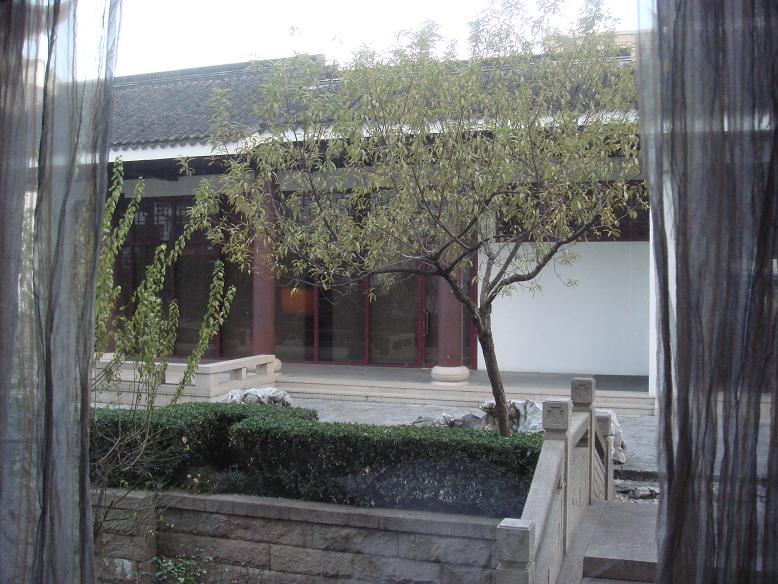


The hotel that we stayed in Suzhou was Pan Pacific which the tour guide claimed it's the best hotel among all the accommodations of our trip. I think the hotel is wonderful too since the guestrooms have a nice backyard view. Its architecture is like an ancient palace with a Chinese style garden in the centre.


Next morning, we visited Master of the Nets Garden 網師園, a UNESCO World Heritage Site. The two trees in front of Master of Nets Garden are Pagoda Trees 槐樹. The Chinese idiom 指桑罵槐 中的「桑」指桑樹,「槐」指槐樹,明明是罵槐樹,卻指著桑樹來罵. In ancient time, only rich family could grow 槐樹 (Pagoda Trees). But sometimes the wealthy ones treated the poors quite badly and it was illegal to point or scold at 槐樹. So people pointed to and scolded at 桑樹 (Mulberry Tree) to express their anger. Later it became a Chinese idiom - pointing to Mulberry but scolding at Pagoda tree.


Suzhou is considered one of the most beautiful cities in China because this place is famous for its classical gardens as we always hear "江南園林甲天下,蘇州園林甲江南" (Jiangnan gardens are the best in China, Suzhou gardens are the best in Jiangnan). Currently Suzhou has more than 200 gardens, some of the finest and representative ones are Great Wave Pavilion 滄浪亭, Humble Administrator's Garden 拙政園, Lingering Garden 留園, Lion Grove Garden 獅子林, Master of Nets Garden 網師園, Retreat & Reflection Garden 退思園. Now let’s go inside to Master of Nets Garden.


Wow, this gateway is very delicate with the exquisite carving! I really love the tiny carved figures.


Suzhou classical gardens were full of romantic ambience 詩情畫意 in ancient time. We can find it in Master of Nets Garden, for example the library (or the reading room) was very pleasant and romantic during the rainy days as the rain drops on the roofs created water curtains and the rain drops on musa basjoo (banana) leaves 芭蕉葉 by the window created nice sounds. In the meditation room, the combination of bamboos drawing and real bamboo trees outside the window creates harmonized scenery. The most popular spot of the garden is its pond with the pavilion where we saw many students drawing or sketching different views of the garden. Can you guess when the garden was first constructed? It was in 1140 during Song Dynasty, more than 800 years already!


Silk was originated in China more than 3000 years ago and it became very popular in the world. I’m sure everyone has heard of the Silk Road which was begun sometime in Han Dynasty (206 BCE – 220 CE) with the export of silk from China to Central Asia (today’s Shinjang 新疆), India, Persia (today’s Iran) and Arabia (today’s Middle East). The route was then expanded to North West Africa and Europe. Within China, Suzhou is the most famous in silk production. We visited a silk factory there to watch the expansion of cocoons. There were many products made from silk including luxurious quilts, beautiful scarves, face and hand creams, silk embroideries. One interesting fact according to our local guide: because the production of silk is very important in Suzhou, industrialization there is prohibited (I think is more likely minimized) since this will affect the quality of mulberry leaves which silkworms 桑蠶 are fed on as mulberry trees are very sensitive to the environment.

Wednesday, June 13, 2012

Trip to China (Part 2) – Wuzhen Water Village


In the afternoon of our second day tour, we travelled to one of the water villages in Jiangnan – Wuzhen 烏鎮. There are six well-preserved ancient water towns in Jiangnan including Luzhi 甪直, Nanxun 南潯, Tongli 同里, Wuzhen 烏鎮, Xitang 西塘 and Zhouzhuang 周庄. Since Jiangnan is located south of the Yangtze River, many streams flow through this region and that is how the water towns were developed. Most of them have long history of over a thousand years. Within the water villages, buildings are situated alongside waterways and stone-paved roads are connected across watercourses with stone arch bridges, which create charming and tranquil scenery. No wonder the ancient water villages in Jiangnan are often called “Venice in the East”.


Above is the tourist map of Wuzhen Xizha (West) Scenic Zone 烏鎮西栅風景區. Wuzhen water village is located in the North Zhejiang Province, just 45 minute bus ride away from Hangzhou. According to its webpage, the town is divided into four zones by a cross-shaped river, with the Beijing-Hangzhou Grand Canal running across the town, making it the only ancient water town adjacent to the canal.


Our tour was focused on Wuzhen Dongzha (East) Scenic Zone 烏鎮東栅風景區 where I saw High Pole Boat, walked through Fengyuan Twin Bridges 逢源雙橋, visited Xiangshantang Medicine Store 香山堂藥店, Ancient Bed Museum 江南百床館, Folk Custom Museum 江南民俗館 and Hongyuantai Dyehouse 宏源泰染坊.


The first thing that attracted my attention in Xiangshantang Medicine Store was the sign posted on the pole in the centre  "貨真價實 誠信無欺" (real products with fair price, honesty with no deceiving). I believe that was the basic concept of Chinese merchants in the past, but the Cultural Revolution has changed all the good concepts.


One of the classical, luxurious beds in Ancient Bed Museum is Babu Qiangong bed 清• 拔步千工床, made in Qing Dynasty with finest materials and complicated techniques. It was finished after 3 years (more than 1000 workdays). The size of the bed is 217cm long, 366cm deep and 292 cm high. Although it is a very elegant, high-quality wooden bed, I don’t think I would feel comfortable sleeping on it as I am used to soft bed.


Visiting Folk Custom Museum reminded me of中國二十四節氣 (Chinese 24 solar terms). The solar terms were invented by ancient Chinese based on knowledge in astronomy, climatology and agricultural meteorology. This system reflected the seasonal changes and was closely related to agricultural activities in ancient China. To make it simple, it has 12 major solar terms and 12 minor solar terms in the lunar calendar:

Start of Spring (立春), Rain Water (雨水) – February
Awakening of Insects (驚蟄),Vernal Equinox (春分) – March
Clear and Bright (清明), Grain Rain (穀雨) – April
Start of Summer (立夏), Grain Full (小滿) – May
Grain in Ear (芒種), Summer Solstice (夏至) – June
Minor Heat (小暑), Major Heat (大暑) – July
Start of Autumn (立秋), Limit of Heat (處暑) – August
White Dew (白露), Autumnal Equinox (秋分) – September
Cold Dew (寒露), Frost Descent (霜降) – October
Start of Winter (立冬), Minor Snow (小雪) – November
Major Snow (大雪), Winter Solstice (冬至) – December
Minor Cold (小寒), Major Cold (大寒) – January

This system and the lunar calendar only applies to China (or maybe East Asia), but sometimes I find it works in Vancouver too! We normally don’t put away our winter clothes until after Dragon Boat Festival (May 5 in lunar calendar) 未食五月粽,寒衣勿入櫳since we believe summer does not actually come before the festival. Now it’s already June but still sometimes cold in Vancouver, let’s see if it will be hot after Dragon Boat Festival (June 23 in western calendar)!


I was told that all the roofs of Zhejiang ancient architectures were built like this. Since the province rains a lot, the rain drops on the roof would create a water curtain!


Hongyuantai Dyehouse was founded between Song and Yuan Dynasty. Wuzhen is famous for its blue calico cloth 藍印花布. In the dyehouse, people use the same traditional methods to hand make the blue calico cloth. The dyeing process is environmental friendly since they use blue grass as dyeing material to make the blue calico. They also use natural grass, tealeaves, bark from mulberry tree and leaves of Chinese tallow tree for the unique process of colour printing.


According to its website, Wuzhen enjoys a history of over 1,000 years since its establishment in 872 A.D. The traditional buildings are still well preserved after crossing so many rough years. Within the town, with a dense network of rivers and wharves, people build their houses along the river and establish markets close to bridges. Stone railings and arch bridges, arched gates across the street, imposing dwellings and spacious courtyards, river banks and verandas are all well preserved.

Sunday, June 10, 2012

Trip to China (Part 1) – Dongyang Woodcarvings City


Last year my blog was mostly about the attractions in town such as Burnaby Village Museum, VanDusen Botanical Garden and Capilano Suspension Bridge. This summer I will share my overseas trips – China and Japan.  Recently many overseas Chinese joined the special Jiangnan tour for CAD 49.00 plus airfare and I was one of them.  It was an exciting trip since I had never been to Jiangnan before and I was curious as to how attractive this area could be since Qianlong Emperor of Qing Dynasty visited Jiangnan so many times (乾隆下江南). Basically the 7 day tour included visit of Shanghai, Suzhou, Hangzhou, Wuxi and Nanjing in 江南 (Jiangnan). 江南泛指長江以南地方,但更多時專指長江下游,江蘇南部和浙江 (Jiangnan refers to south of the Yangtze Rivera region in the lower Changjiang (Yangtze) valley, including southern Jiangsu and Anhui and northern Zhejiang).  

I travelled to China in mid-October last year by flying to Shanghai Pudong International Airport first. The tour guide picked us up from the airport. There were 24 people in our tour including 14 from Australia, 6 from Canada, 2 from US and 2 from New Zealand. Even though we were all Chinese, it was my first time meeting overseas Chinese from Australia and New Zealand. We had several seniors in the group with the eldest of age 83.

The highlight of first day trip was Dongyang Woodcarvings City 東陽木雕市 located in Zhejiang province. Dongyang wood carving has long history since it was developed in Tang Dynasty (618-907). During Qing Dynasty (1736 – 1796), over 400 Dongyang craftsmen were asked to produce the royal carvings in the Imperial Palace in Beijing.

Here are some of the exquisite woodcrafts made by Dongyang craftsmen. Our tour guide described their masterpieces as 鬼斧神功.

This one is a very simple craft work but I would like to post it here since we have many cute squirrels in Vancouver!

柳毅傳書 - carved in 1980s using basswood (椴木). 柳毅傳書 (Liu Yi-The Messenger) is one of the famous Chinese legends.

Carving of Legend of the White Snake (白蛇傳), a very famous Chinese folk legend.

 Lotus in Water - carved in 2002 using basswood

 A set of boxes, hundreds of birds worship the phoenix - carved in 1960s using camphor and basswood.

 Wood sculpture of human figure – beauty of an ancient woman.

Besides woodcarvings, Dongyang is also famous in bamboo plaiting and carving. Here’s a fisherman figure made of bamboo.

Thursday, December 29, 2011

New Year Wish for Baby Pigs


Happy New Year! Not only to humans but also to piglets! Recently the international animal rights have been very active in shark fin ban and the result is becoming successful. Shark fins will no longer be sold or used in food in California starting in 2013 … Hong Kong top hotel, Peninsula, will stop serving shark fin soup in 2012... No doubt I agree the prohibition to protect the sharks since their fins have been used extensively for soups at Chinese weddings and banquets. But besides the shark fin soups, there is another popular dish at Chinese weddings or banquets that contains cruelty, at least in my opinion. It is 乳豬 or roasted suckling pig! As its name means – suckling pig is a piglet fed on its mother's milk and is slaughtered between the ages of two and six weeks (燒乳豬是將二至六個星期大,仍未斷奶的乳豬宰殺).


How brutal and inhuman to kill the lovely baby piglets to satisfy humans stomachs!!! Why didn’t the world try to ban the practice of roasted or cooked suckling pigs? Because the use of suckling pigs for dishes is also happened in Western culture especially the Spanish-speaking countries such as Spain, Cuba, Puerto Rico, Colombia, Peru, Costa Rica and the Dominican Republic. It is also a recipe in Southern United States and Germany. I know it’s not easy to convince everyone not to eat suckling pigs but at least I wish people would think twice and have mercy on the cute little piglets before they start eating them.

Sunday, October 9, 2011

Dr. Sun Yat-Sen Classical Chinese Garden in Vancouver

Tomorrow will be the 100th anniversary of 1911 Chinese revolution (辛亥革命). This revolution was started on October 10, 1911 led by Sun Yat-Sen (孫中山 or 孫日新) to overthrow Chinese imperial system which had been existed for over 2000 years. I visited Dr. Sun Yat-Sen Classical Chinese Garden (中山公園) in Chinatown, Vancouver on July 17. Built in 1985 and officially opened in 1986, it is the first full-scale classical garden constructed outside of China. It is modeled after private classical gardens in Suzhou during Ming Dynasty (1368 – 1644). Since it happens to be 100th anniversary of 1911 revolution, I posted the photos of Dr. Sun Yat-Sen Classical Chinese Garden.

Since Song Dynasty (960 – 1279), Suzhou has been an important centre for silk industry.


A classical Chinese garden has four main elements:
Buildings – such as pavilions and covered walkways
Rocks - especially Tai Hu limestone rocks from Suzhou
Plants – such as pine trees, plum trees and bamboos
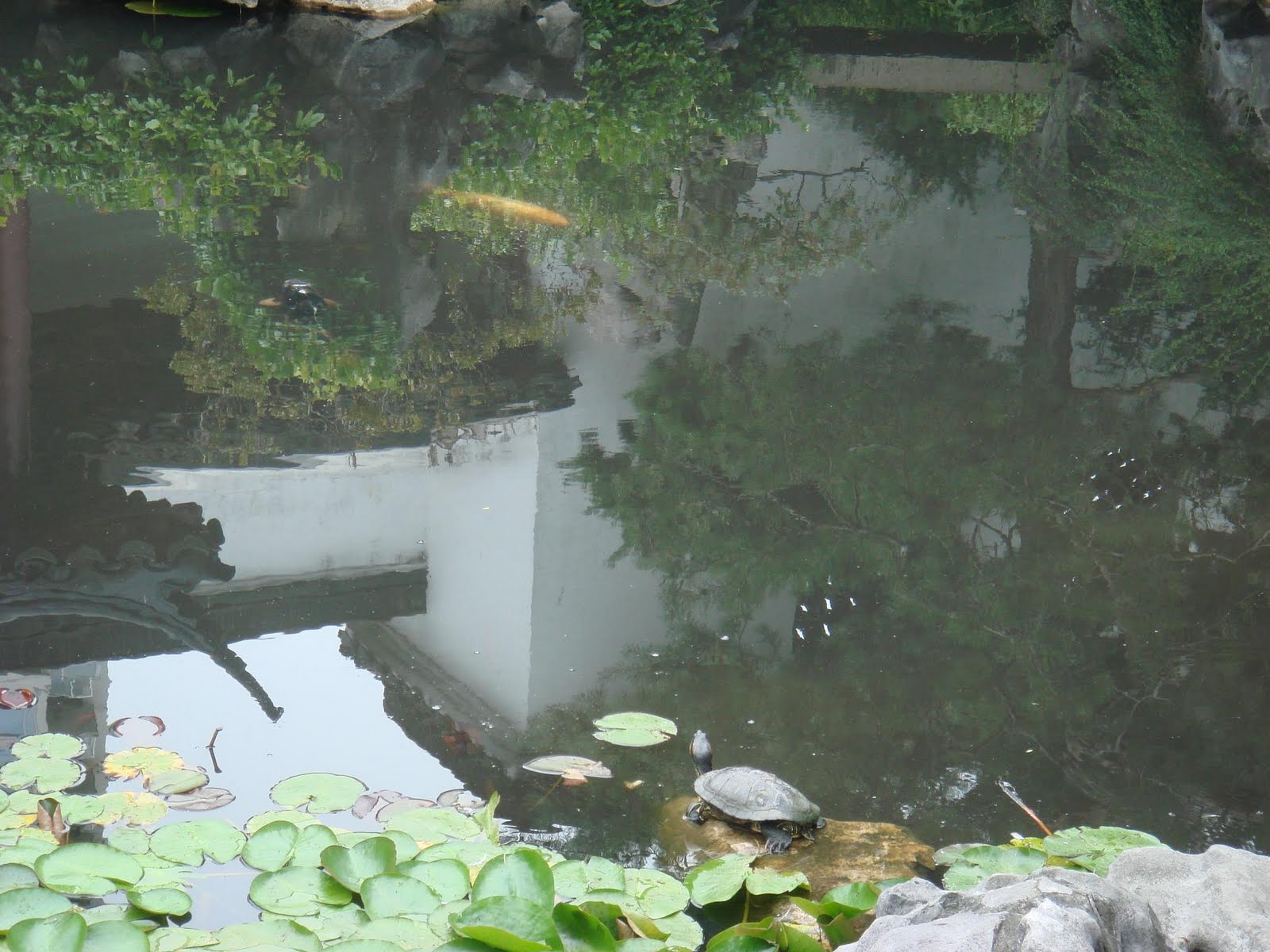
Water - a central pond with koi fish, and sometimes turtle and mandarin ducks

Photo Below: I believe this is called "Moon Gate" - a moon-shaped doorway

Poetry is also an important element in a Chinese classical garden. Poems can be found anywhere in the garden – inside or outside the buildings and sometimes craved into rocks. Poetry is the way people express their feelings of the beauty and nature in the garden.


I think golden Koi fish symbolizes luck and wealth, turtle symbolizes longevity in feng shui concept.
A very cute little blond girl is watching the Mandarin ducks. In Chinese culture, Mandarin ducks represent a life-time couple with love and romance. They are called Yuan-Yang 鴛鴦 and always in a pair.
In Chinatown, there is a Dr. Sun Yat-Sen Park next to Dr. Sun Yat Sen Garden. Unlike the garden, the park is free to the public. The difference is the garden was constructed by Chinese artisans and craftmen using materials from China while the park was constructed by local architects and workers using materials from North and South America.


I'm glad to have a chance to visit this garden before I visit the classical Chinese garden in Suzhou this October (a week from now). This garden was constructed by master craftmen from China using traditional methods with no glue, screws or power tools. Everything was consturcted in accordance with feng shui and the balance of yin yang to create a harmony environment. Now I know what to expect when visiting the famous Chinese garden in Suzhou!