Wednesday, July 18, 2012

Trip to Japan (Part 2) – Cape Irago in Atsumi Peninsula


On the second day we travelled to Cape Irago 伊良湖岬 in Tahara City 田原市, which is situated in Atsumi Peninsula 渥美半島, the most southern part of Aichi Prefecture. Even though Tahara is not a popular tourist place for foreigners, I was attracted by the online photos of its Irago Lighthouse and Koijigahama Beach. I found this city very lovely by reading its information. There are several projects making it into an eco garden city: introduction of solar generated power at its public facilities, use of waste vegetable oil as fuel for school buses, and recycling of combustible wastes into carbon.

From January to March, colza flowers 油菜花 can be found in the fields and also along the streets of Atsumi Peninsula. Cherry trees 櫻花 are in bloom around late March and early April in Atsumi Peninsula. If I had visited Tahara three weeks earlier, I may have had a chance to see the beautiful view of colza flowers with cherry blossoms at the same time. We have blueberry and strawberry picking in Vancouver while they have strawberry and melon picking in Tahara.

In the morning we took the train “Meitetsu Kowa Line” 河和線, from Nagoya Station to Kowa Station 河和駅. Instead of riding a free shuttle bus to the ferry station in Kowa, we went there by foot.


Kowa is a small and quiet town. On the way, we saw this private house with flower pots in its front and side yards! How lovely J


After 10 minute walk, we reached Kowa ferry station. The size of the ferry station was small (I think less than 1000 sq ft.). In the station, there were ticket centre, brochure section, tiny convenience store, vending machines with hot and cold beverages, and three or four sofas.


This was the high-speed ferry 高速船 we boarded. There were three stops: Himakajima 日間賀島, Shinojima 篠島 and Irago 伊良湖. The ferry travelled along Mikawa Bay and first reached Himakajima where the size of the island is 0.75 km2  with 6 km coastline. Even though the island is very small, it has population of more than 2000. You can see how many local tourists in Himakajima from the photo. I think they came there mainly for fishing and enjoying the seafood such as octopus and blowfish in restaurants.


I saw quite a few fishing vessels on Mikawa Bay, there must be plenty of fish in the bay since many people were fishing near the port of Himakajima, Shinojima and Irago respectively. After 50 minutes of ferry ride, we finally arrived at Irago. YEAH! I saw a little girl carrying a huge backpack … suddenly the cartoon girl from animation “My Neighbour Totoro” 龍貓/となりのトトロ came up in my mind.


There are two paths to Irago Misaki Lighthouse 伊良湖岬灯台: either by the shore or along the trees. Somehow we walked through the latter one where we didn’t see anybody around except one Caucasian cyclist. I thought I would be the only foreigner there since I only saw local Japanese from Kowa to Irago.


Let’s keep walking! What a beautiful day! Do you know what ocean is this?

Answer: Pacific Ocean 太平洋

Ahead was another famous spot - Koijigahama Beach 恋路ヶ浜, an approximately 1 km long sand beach. It forms a smooth curve shaped like a bow.


I think it talks about the plants can be found along Irago Cape and the picture shows distribution of different species on the beach.


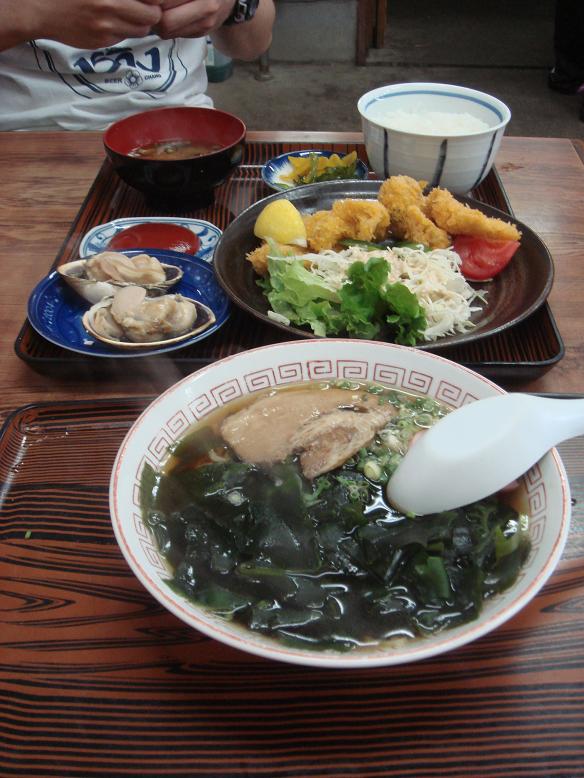
Atsumi Peninsula is famous for O-Asari (giant short-necked clam) 渥美の貝, almost every restaurant offered roasted o-asari as signature dish. After walking along Koijigahama Beach, we found a few restaurants which were located side by side to each other. They were typically divided into two sections – with the front selling souvenirs, local snacks, fruit, and coconut juice, the back serving meals to customers. Since it was weekend and also the Golden Week, many restaurants were quite full. We picked the one with one or two empty tables. I forgot what exactly we ordered from the menu, I think it’s the ¥ 1400 meal set from 定食 and ¥ 600 or ¥ 650 noodle bowl from 麵. I tried the roasted o-asari which was okay, it tasted different from the clams I had before. I also tried the clam filet (the ones with the salad, I think they were deep fried).


Here’s another scenic spot – Lover’s Sanctuary, just across the restaurants. Ring the bell … Ding Ding Ding!!! Oh … graffiti on the public property! I thought Japanese are quite discipline, still I could find a waste bottle in the sea and graffiti in Irago. Well, Vancouver is the same too. I wonder what country is free of graffiti and litter, maybe Singapore?


This time we walked along the shore back to the Port of Irago. On the way I saw quite a few stones with poems. The poems were not all written by poets, some were from high schools and even elementary schools. Maybe I could guess the content by reading some kanji. For example, pond 池 something something water 水, wind 風 something something rain 雨, lake 湖 something something moon 月(乜乜池乜乜水乜乜風乜乜雨乜乜湖乜乜月) Anyways, they are all about the beauty of nature, I think. It’s interesting that the poems were not necessary about the scenery of Cape Irago, they could be anything such as offsprings 子孫 and miscarriage 流產.


Upon return to port of Irago, we still had 30 minutes before the ferry departure. So I tried the melon ice cream (delicious J) and shopped in a medium size supermarket where it sells Tahara specialities, local souvenirs and even specialities from Okinawa. After shopping, my friend suddenly yelled at me. What’s Wrong??? OH! I got sunburn on my arms. That’s the high speed ferry for the ride back to Kowa.


After we got back to Kowa, we walked to the train station. This time we had to transfer to another train at Fuki Station富貴. 富貴 in Chinese characters means wealthy but the town was as small and quiet as Kowa. Maybe local residents are mentally wealthy which is a happy sign!

While on the train to Kanayama 金山, I was looking at the screen displaying news in Japanese words which contained kanji, haragana and katakana. I read 王子 (prince), 英国 (England), 記念日 (anniversary) … OH! April 29, the wedding anniversary for Prince William! My friend was shocked that I could understand the news!!! Actually in Japan 50% chance I could read since part of their writings contain kanji, just the same as Chinese characters 漢字.


For dinner, my friend brought me to a restaurant serving very local Nagoya cuisine in Kanayama 金山. I recall it was located below ground and some small sandalwood incense coils 檀香 were placed at the corner of its stairs. The light was a bit dim, not sure if a typical or traditional Japanese restaurant is like that? To order or request for a service, just ring the bell on table. We ordered appetizer (the rectangular plate with tiny fish in the centre), something with red miso paste in a leaf (好濃味呀! Too Strong!), pork cutlet with red miso sauce (same comment), deep fried chicken wings (tasted okay, a bit spicy with pepper favour), clam soup and edamame beans. Of course my favour dish, dessert, would not be missed!

Monday, July 16, 2012

Trip to Japan (Part 1) – Nagoya City


When I was a kid, my impression of Japan was “the Kingdom of Cartoons” since I watched many Japanese cartoons in my childhood such as 機靈小和尚/一休小和尚 (Ikkyū-san), 叮噹 (Doraemon), 忍者小靈精 (Ninja Hattori), IQ博士 (Dr. Slump), 黃金戰士 (Golden Warrior Gold Lightan), 足球小將 (Captain Tsubasa), 我係小忌廉 (Creamy Mami), Q太郎 (Q-tarō), 外星小美兒 (Little Memole), 黃毛仔 (Jungle Kurobe), 六神合體 (Six God Combination God Mars), 甜甜小公主(Anmitsu Hime) … the stories of its cartoons were very broad, including ordinary stories like Buddhist monk, ninja, soccer players and creative or imaginative stories like robotic cat from the future, a giant golden robot transformed from a gold lighter, a little girl transformed into a beautiful teenager with a magical wand and a very tiny girl from another planet.

Today’s Japan, in my mind, is still an advanced country with unique culture and innovative products. I know a few people were extremely fascinated by its land and culture so I was very curious to find out the attractive elements of this island country since I had never been to Japan before.

I had decided to visit central Japan with Nagoya 名古屋 as my first destination. Nagoya is located in Aichi Prefecture 愛知縣, west of Tokyo and east of Osaka. It is the largest city in central Japan (Chubu region) and the 4th largest city in the country by population after Tokyo, Yokohama and Osaka.

I bought my air ticket in mid-February. A week later, I was quite upset with mayor of Nagoya since he said to a Chinese official: “there regrettably were conventional battles in Nanjing, but there was no massacre” WHAT! Did it mean he thinks the killing of 300,000 people in Nanjing with the murders, rapes, loots done by the Japanese army in 1937 should not be considered serious crimes? Based on his concept, killing and no killing are the same … dead and alive are the same … heaven and hell are the same. Anyways, I would still travel to Nagoya since the air ticket with accommodation worth $1900 CAD was not refundable!

On April 26, I flew to Narita International Airport 成田國際機場 first and connected to a domestic fight to Chubu Centrair International Airport 中部國際機場. On the plane to Narita, I was sitting by window. In front of my seat were two Caucasians and the one beside me was also Caucasian. During meal time, a flight attendant showed pictures of beef and chicken to the Caucasians. Let’s see which one to point when she shows the pictures to me …ローメ#%丫??? She thought I could understand Japanese … sorry I don’t, I need pictures.

I finally arrived at Chubu Centrair International Airport after more than 11 hours of flight, somehow I was not feeling well. Uh oh! Probably due to the long-time trap on the plane (I should have picked the aisle seat) and the rush time for flight connection (I only had less than one and a half hour).

My friend picked me up after 6:30 pm on April 27 (Japan is 16 hours ahead of Vancouver) and we had dinner in Suzumani 鈴波 at the airport.


These were our orders from Suzumani, the restaurant is famous in grilled and marinated fish. As for dinner, I think the price was reasonable ¥ 1000 – 1800 (about CAD 12 – CAD 22) per set with no tip required. The combo included rice, tofu, sashimi, grilled fish and pickles 漬物. A small glass of alcohol (around 25 ml, maybe sake?) was provided for each of us. I asked my friend the difference between 定食 and 御膳 on the menu. He explained that 定食 means set menu while 御膳 means a deluxe combo. Okay, that made sense since 御膳 in Chinese means imperial meal, meal served in the royal family.

Next morning we took Meguru bus to Noritake Garden and Nagoya Castle. Meguru bus is a Nagoya sightseeing route bus departing from Nagoya Station. Single ride was ¥ 200 while one day pass was ¥ 500, so each of us bought a one day pass which was about CAD 7.50. The first stop was Toyota Commemorative Museum of Industry and Technology which my friend told me Toyota was a textile machinery company before it became Toyota Motor Corporation. We got off at the second stop, Noritake Garden.


Admission to Noritake Garden ノリタケの森 was free except its craft centre which costs ¥ 500 per person. Since we purchased Meguru one day pass, we only needed to pay discounted price ¥ 450 each. When I entered into the garden, I felt it’s more like a park. We saw this pond with a sign “Biotope” … a place whose natural environment has been recovered, enabling plants, insects, fish, birds and other animals to coexist. It is designed to propose a way for humankind to live in harmony with nature. Human beings have always produced pottery out of soil taken from the natural environment. Noritake hopes to treasure earth, soil and nature, so that it can always be with them and make ceramics.


I believe these are the old chimneys covered by leaves. The carp steamers are called koinobori 鯉幟 and are used to celebrate Tango no Sekku 端午の節句, also known as Boy’s day on May 5 which the date was approaching at that time. I found this quite interesting since 端午節 on May 5 of lunar calendar was originated from China. I think it was introduced into Japan and when the country decided to“leave Asia, join Europe” 脫亞入歐 in late 19th century, they changed the date of 端午節 from May 5 of lunar calendar to May 5 of western calendar and changed the meaning of 端午節 to the celebration of boy’s or son’s happiness.

Noritake is a leading company in the Japanese ceramics industry. When I visited its craft centre, I could see the staff working seriously and delicately on the porcelains. The final procedure was quality check in which not only by seeing but also by hearing the sound.


Noritake garden is a very nice and relaxing place for everybody to visit. There was a group of kids learning English from their Caucasian teacher on the meadow. They were learning vocabulary “crocodile” and the teacher hid some eggs along the bushes for the kids to discover. Some families had picnics in the park with kids playing around. We had lunch on the patio of Square Cafe there. Since my stomach wasn’t feeling good, I only ordered light sandwiches with tea. The cafe had peach ice cream which I’d like to try if my stomach had been better. In front of the cafe was a long table with blank koinobori which all the kids were welcome to draw anything on it.


After lunch we were heading to Nagoya Castle by Meguru bus. Again we had discount for the admission, original was ¥ 500 each, now ¥ 400 each. The construction of Nagoya Castle 名古屋城 was completed in 1612 by the order of Tokugawa Ieyasu 徳川家康. Tokugawa was a significant Japanese warrior who founded the Tokugawa dynasty of shoguns 德川時代 (or called Edo period 江戸時代) in Japan. The main gate and the donjon were destroyed in WWII then restored in 1959, the Hommaru Palace was also destroyed in WWII and still not yet being reconstructed.

Since Nagoya Castle is a symbol of the city, I think it was one of the must see attractions. Too bad I just missed the cherry blossoms by about two weeks otherwise it must be very beautiful. I only saw one or two cherry blossom trees around the castle by the time I got there. What are the golden figures on the roof of the main donjon? They are kinshachi or golden dolphins 金鯱 as symbol of the lord’s authority.


We went to the top floor of Nagoya castle where we found lots of tourists, both domestic and international. Here’s one of the views of downtown Nagoya from the top. Full of buildings, higher density compared to Vancouver and lower density compared to Hong Kong.


Model of Ancient Nagoya Castle and City – density was much lower back to 400 years ago and homes were much bigger.


Drawing of people’s lives in the city of ancient Nagoya, seems very prosperous.


I can only read some words on this poster as kanji 漢字 are basically the same as Chinese characters. To the best of my guess, the design of  本丸御殿/上洛殿 (Hommaru Palace?) maybe adapted from Chinese feature of Imperial Palace.


Actually I’m not 100% sure if the palace design was made according to the draft of Chinese palace. But I can tell Chinese culture had a great influence in Japan during ancient time from the  wall paintings. These are some of the Hommaru Palace sliding screens displayed in the donjon. Their styles and use of colour are very similar to Chinese art.


After getting out from the donjon, I was thirsty and I needed hot drink since my stomach wasn’t well. My friend tried to find one for me from the vending machine. There were lots of vending machines with many kinds of beverages in train stations, on streets, in hotels and tourist attractions, but they were all selling cold drinks since it was hot there (around 20 °C). Finally we found one with hot beverages, the only one in Nagoya Castle. My friend told me that there are many vending machines with hot beverages in winter.

I wanted to take Meguru to the Japanese garden Tokugawaen but it was late afternoon already so we took Meguru back to Nagoya station. That was the first day of my Japan trip which was very nice and enjoyable.

Saturday, June 30, 2012

Trip to China (Part 7) – the largest city in China, Shanghai


After Hangzhou, we returned to Shanghai 上海. According to my research, Shanghai is the largest city in the world by population with over 18 million residents and also the busiest port in the world in terms of cargo tonnage. Shanghai, as a global city, is a major financial and business center in China.

Shanghai is located on China’s eastern coast at the mouth of Yangtze River that pours into the East China Sea. It borders Jiangsu and Zhejiang provinces to the west. In history, Shanghai was a fishing village until Song Dynasty when it was upgraded to a market town in 1074. During Qing Dynasty, Shanghai became an important trade port in Yangtze Delta region.

In the 18th century, United Kingdom had a trade deficit with China since British purchased goods from China such as tea and silk while Chinese did not buy much from UK. To reduce the trade imbalance, British started selling opium to China. Soon many civilians in China were addicted to opium and their health became very bad. The government of Qing Dynasty sent the official Lin Zexu 林則徐 to ban the opium trade with UK, and this caused the First Opium War 鴉片戰爭. Because China lost in the battle, the Qing government was forced to sign the Treaty of Nanjing in 1842 which allowed British to dictate opening the treaty ports, Shanghai included, for international trade.

Later on, China was forced to lease out lands in Shanghai as concession territories to UK, USA, and France where it became 英租界, 美租界 and 法租界. This is called “Shanghai International Settlement” which lasted until the end of WWII.

Due to the special situation, Shanghai became a large city and home to many foreigners. In 1930s, it was the most important financial center, the largest and most prosperous city in the Far East.

Do you know the official abbreviation of Shanghai? In China each province has its own abbreviation. For example, the abbreviation for Jiangsu 江蘇 is 蘇 (Su), for Zhejiang 浙江 is 浙 (Zhe). Four most important municipalities including Beijing, Chongqing, Shanghai and Tianjin are also granted with an official abbreviation. For example, the abbreviation for Beijing 北京 is simply 京 (Jing). So what about Shanghai … if you live in Vancouver, you have probably heard of or been to the restaurant “Shanghai River” 滬江 in Richmond. The hint is very obvious already. Answer: 滬 (simplified character 沪; English: Hu)

It is nice to know the abbreviations since they appear on all motor vehicle license plates in China. The ones I saw most during this trip were starting with 蘇A, 蘇B, 蘇E which represent Nanjing (the capital city), Wuxi and Suzhou respectively, and 浙A for its capital city Hangzhou. Another one I saw a lot on the highways which I got no clue was 皖? It actually represents 安徽 (Anhui), a neighbour province to Jiangsu and Zhejiang.


Here’s the skyline of Pudong in the day and evening. Shanghai downtown is separated into two districts by the Huangpu River 黄浦江, the last tributary of Yangtze before it flows into the East China Sea. Pudong 浦東 is a new district on the east side of Huangpu River 黄浦江. It is now an area with all the financial centers. The airport we landed is Shanghai Pudong International Airport 上海浦東國際機場 which was opened in 1999. Puxi 浦西 is a historic center of the city located on the west side of Huangpu River.

To bring us back mentally to the prosperous Shanghai in 1920s, our tour guide sang us a song “浪奔 (登登登) 浪流 (凳凳凳) 萬里滔滔江水永不休”... haha, a very famous Cantonese song from a super popular classical TV drama 上海灘 (The Bund) released in 1980. This TV series is about an action and romantic story set in Shanghai during the International Settlement period.

The real show we watched in Shanghai is a performance by Shanghai Era Entertainment which we saw the spectacular combination of traditional Chinese acrobatic arts and modern technology! Although the performance team was all Chinese, the production team including creator /visual director and composer/music director was from Canada. It was a full house 坐無虛席. After the show when everyone was coming out to look for their groups, I saw lots of flags … flags of local tour groups and foreign country flags for the Caucasian groups. It was like a gathering of 八國聯軍 (Eight-Nation Alliance).


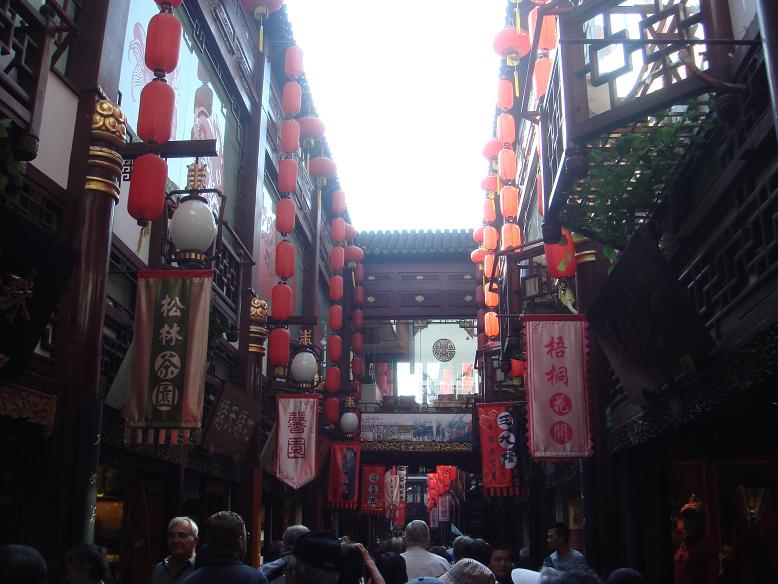
Next morning also the last day of the trip, we visited City God Temple of Shanghai 上海城隍廟. In the old days, City God Temple referred to a Taoist temple here. Now it refers not only the temple but the surrounding area with hundred stores and shops such as Chinese restaurants, Chinese boutiques, Chinese medicine herbal stores, Starbucks, Dairy Queen and Haagen Dazs, etc. It was full of tourists, both Chinese and foreigners.


There was a very long lineup to 南翔饅頭店 where the famous steamed dumplings or little basket buns 小籠包 can be offered. What is special about 南翔 Nanxiang? How come it’s called 饅頭 (mantou) not 小籠包 (xiaolongbao)?

Today’s little basket buns were originated from 南翔 Nanxiang, a town located in Jiading district 嘉定區 where is a suburb of Shanghai. In 1871, a man named 黃明賢 created the little basket buns in his store next to the famous park, Guqi Garden 古猗園. Due to its popularity, it has expanded into downtown Shanghai including this one in City God Temple area.

Before Song Dynasty, 饅頭 (mantou) meant both filled and unfilled buns. Nowadays, mantou still describes both filled and unfilled buns in Jiangnan while it only describes unfilled buns in many parts of China. So 小籠包 (xiaolongbao) is considered a type of mantou called 小籠饅頭 (xiaolongmantou) in Shanghai.

According to Wikipedia, the name mantou is cognate to manty and manti; these are filled dumplings in Turkish, Persian, Central Asian, and Pakistani cuisines. In Japan, manjū (饅頭) usually indicates filled buns, which traditionally contain bean paste or minced meat-vegetable. In Korea, mandu (饅頭) can refer to both baozi (包子) and jiaozi (餃子). In Mongolia, mantuu are basically the same as the Chinese mantou.


The folk handicrafts are very nice. I especially like the snuff bottles with beautiful Chinese inner painting (the use of a special paintbrush at a 90-degree angle to paint inside glass or crystal objects).


China has 55 ethnic minority groups that occupy 8.5% of the Chinese population and the guy with white cap in this photo must be one of them. The blue sign “Jiujiaochang Road” clearly indicates the direction of north (N) and south (S), I think the design is good as it makes the directions very clear.


I was not surprised to see Muslim restaurant in Shanghai airport since there are 10 Muslim ethnic groups in China. To name a few: Hui 回族, Uyghur 維吾爾族, Kyrgyz 柯爾克孜, Salar 撒拉族 and Uzbek 烏孜别克族. Now Muslims are found in many regions of China. It is believed that Islam was brought into China more than 1200 years ago. But the greatest movement of Islam into China was in Yuan Dynasty (1271 – 1368) when the Mongol conquest of Central Asia and Persia, brought millions of administrators, generals and scientists into China. No wonder I saw quite a few 清真館 (Halal restaurants) there.

Overall, this trip was nice and enjoyable. The tour guide and bus driver did fulfill their responsibilities. Everyone in our tour group was friendly. One girl was about the same age of mine and we became good friends, hopefully we will stay in touch. A beautiful senior woman 靚婆婆 (age 79) told me that I’m the same age as her granddaughter before she left … but I think I might be much older than her granddaughter though. I am especially thankful for those who helped to take care of or entertain my mom when I was busy taking photos in the trip J

Monday, June 25, 2012

Trip to China (Part 6) – Hangzhou West Lake


After the visit to Nanjing, we were heading to Hangzhou 杭州. It was supposed to be a 2 hour bus ride from Nanjing to Hangzhou. Let’s give a brief introduction of the city …

Hangzhou, the capital and the largest city of Zhejiang province, is at the south end of Beijing-Hangzhou Grand Canal. It is about 100 km southwest of Shanghai. The city of Hangzhou was founded during Qin Dynasty (221 BC – 206 BC) as Qiantang County 錢塘縣, more than 2000 years ago!

Hangzhou is famous for its beautiful natural scenery with the West Lake as the best-known attraction. Even the famous Italian traveller Marco Polo who came to China during Yuan Dynasty (1271 – 1368) described Hangzhou as the finest and the noblest city in the world. No wonder we always hear the Chinese saying: 上有天堂 下有蘇杭 (heaven above, Suzhou and Hangzhou below) to express Hangzhou is a paradise on earth. But our Nanjing local guide said when he asked the Chinese Malaysians “上有天堂”(heaven above), the reply was “下有地獄”(hell below).


Here’s the photo taken when we were travelling on highway. There are lots of rice fields alongside, it is believed that rice was first domesticated in the region of Yangtze River valley in China.

The traffic was getting very bad after an hour on highway. It started to rain. Since all the vehicles were stuck there, two lanes became four lanes as many cars were trying to cut into the lines. Wow! The driving technique there is something we will not and never be able to learn! We thought there must be an accident, in fact it was a road construction that caused the terrible traffic jam. Not only the lanes were doubled, travel time was doubled too … 2 hour ride became 4 hour ride. So we were late for the show “Night of West Lake” which presented the culture of Hangzhou West Lake by five acts including the King Reviewing the Soldiers, Prosperity of Qiantang, Butterfly Lovers, Elegance of Qiantang and Oriental Buddhism. We missed the fist two acts though, but still everyone enjoyed it very much!


Next morning, we visited Meijiawu Village 梅家塢 where is the plantation of organic dragon well tea 龍井茶. West Lake Dragon Well Tea 西湖龍井茶 is considered the finest green tea in China, it is also ranked the first in top-ten Chinese teas for its four wonders - green colour, fragrant aroma, sweet taste and beautiful shape. There are many dragon well teas in the market, but the best and authentic ones should be from the mountains around West Lake such as Shifeng 獅峰 , Longjing 龍井 , Yunqi 雲棲, Hupao 虎跑 and Meijiawu 梅家塢 where the climate is mild with plentiful rainfall. Once again, it’s easy to memorize … 獅龍雲虎梅 (Lion Dragon Cloud Tiger Plum). Lion 獅峰 is ranked the first among them.

To be more specific, dragon well tea leaves are picked during different periods based on Chinese 24 solar terms. The best tea is picked before Qingming 清明 (Clear and Bright in early April), which is called Mingqian Tea 明前龍井. The tea leaves picked before Grain Rain 穀雨 in mid-April are fairly good and are called Yuqian Tea 雨前龍井.

Somehow I recall Hangzhou local guide said each house in this area has solar energy installation and I remember seeing houses with solar panels on the roofs.


The most famous attraction in Hangzhou is West Lake 杭州西湖. In history, West Lake has influenced poets and painters for its natural beauty and it has been among the most important sources of inspiration for Chinese garden designers. It is also where many romantic stories and legends such as "The Butterfly Lovers" 梁山伯與祝英台, and “Legend of the White Snake" 白蛇傳 took place. West Lake Scenic Area covers 60 square kilometres of which West Lake itself occupies 5.6 square kilometres.

There are ten best-known scenic spots on the West Lake named as the "Ten Scenes of Xi Hu" 西湖十景:

Dawn on the Su Causeway in Spring (蘇堤春曉)
Curved Yard and Lotus Pool in Summer (曲院風荷)
Moon over the Peaceful Lake in Autumn (平湖秋月)
Remnant Snow on the Broken Bridge in Winter (斷橋殘雪)
Leifeng Pagoda in the Sunset (雷峰夕照)
Two Peaks Piercing the Clouds (雙峰插雲)
Orioles Singing in the Willows (柳浪聞鶯)
Fish Viewing at the Flower Pond (花港觀魚)
Three Ponds Mirroring the Moon (三潭印月)
Evening Bell Ringing at the Nanping Hill (南屏晚鐘)

Did you notice the long arched stone bridge in one of the above photos? It’s called “Broken Bridge” 斷橋, where Lady White Snake 白娘子 and scholar Xu Xian 許仙 met each other and fell in love according to the very famous Chinese folk story 白蛇傳 “Legend of the White Snake”.

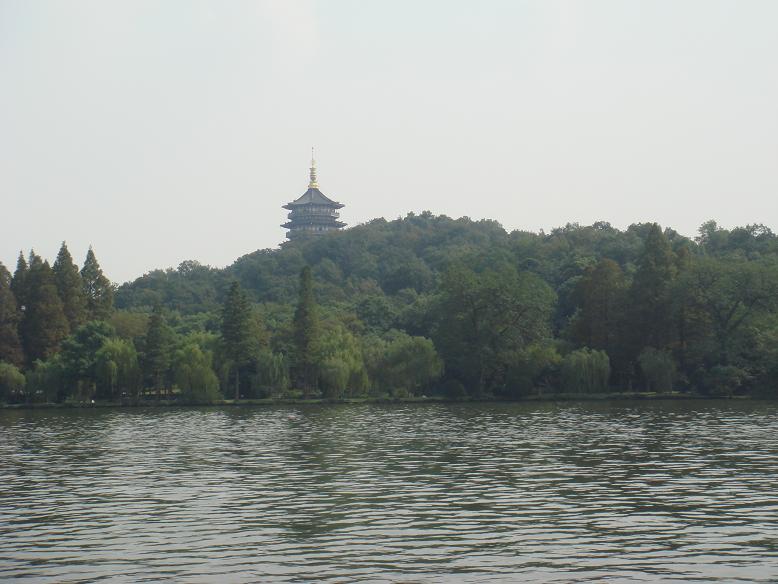
The pagoda in another photo is Leifeng Pagoda 雷峰塔, a five story tall tower with eight sides located on Sunset Hill at the south of the West Lake. Originally constructed in Five Dynasties and Ten Kingdoms period (AD 975), it collapsed in 1924 and then was rebuilt in 2002.


Fish Viewing at the Flower Pond 花港觀魚 is one of the top ten West Lake scenes. It was built between the hills and the West Lake 800 years ago in a private garden of an official in Song Dynasty. It's called the Flower Pond (or Flowery Pond) since a clear stream from Huajia Hill (Flowery Hill) 花家山 ran through here and down into the West Lake.

The bottom right photo is the sign “花港觀魚”written by Kangxi Emperor 康熙皇帝 in 1699. How come the bottom part of 魚 (fish) was written as three strokes of water radical (氵) not the four strokes of fire radical (灬)? Because the fish here is for viewing not for cooking as they only live in the water, not on the fire (never cooked).