Saturday, June 23, 2012

Trip to China (Part 5) – the Southern Capital, Nanjing


On the fifth day we visited Nanjing 南京, the capital of Jiangsu province. Nanjing had experienced the darkest history in WWII when brutal massacre was conducted by Japanese Army there. Our tour guide mentioned about Nanjing Massacre Memorial Hall 侵華日軍南京大屠殺遇難同胞紀念館 which was not included in our trip so that we would not lose appetite to the “great” cuisines!

As everyone knows, the national capital of China is Beijing. Beijing in Chinese means Northern Capital while Nanjing in Chinese means Southern Capital. In history, Nanjing was capital of the Six Dynasties, capital of Ming Dynasty and capital of Republic of China.

The period of Six Dynasties was between the end of Han Dynasty 漢朝 (206 BC-220 AD) and the beginning of Sui Dynasty 隋朝 (589-618). They were Wu 吳 in Three Kingdoms Period (222-280), Eastern Jin 東晉 (317-420), Liu Song 劉宋 (420-479), Southern Qi 齊 (479-502), Liang 梁 (502-557), and Chen 陳 (557-589).

Zhu Yuanzhang, the founder of Ming Dynasty 明朝 proclaimed Nanjing as the capital in 1368. At that time, Nanjing was the largest city in the world (1358-1425). Zhu Di, the forth son of Zhu Yuanzhang and the third emperor of Ming Dynasty moved the capital to Beijing in 1421.

In 1912, the leader of Chinese Nationalist Party, Sun Yat-Sen, overthrew the Qing Dynasty and created the Republic of China with Nanjing as the capital. Chinese Nationalist Party was defected by Chinese Communist Party in 1949, since then Beijing became the national capital.

Because Nanjing has served as the capital of China several times in the history, it is considered one of the Four Great Ancient Capitals in China 中國四大古都之一.


Here’s Sun Yat-Sen Mausoleum 中山陵 situated at the southern foot of the Purple Mountain 紫金山.


Let’s start going to the tomb! There are 392 steps which seems time and energy consuming to climb. In fact, the flat steps make visitors comfortable to walk and I only spent 15 minutes to reach the top! Some women even wore high heel shoes to go up. The slope grassland in front of the tomb was decorated with “辛亥百年 1911-2011” since it was 100th anniversary of 1911 Chinese revolution which was started on October 10, 1911 led by Sun Yat-Sen to overthrow Chinese imperial system which had existed for over 2000 years.


Once I reached the top, I went straight and entered into the mausoleum. Since I didn’t take photos inside, I only recall seeing a huge statue of Dr. Sun Yat-Sen. There should be a flag of Chinese Nationalist Party on the ceiling which I didn’t pay attention. When I got out from the mausoleum, I was totally attracted by the view … it was very spectacular with the area surrounded by forests! Did you notice from the picture that you cannot see any of the steps from the top? Wow … what an amazing design!

On the way back to the bottom, I saw a hole on the traditional Chinese bronze tripod which was caused by Japanese bombardment in December 1937.

There is another historical site at Purple Mountain which we didn’t have a chance to visit – Ming Xiaoling Mausoleum 明孝陵. It is the tomb of Zhu Yuanzhang, the first emperor of Ming Dynasty, with the Queen Ma. The construction of this mausoleum was completed in 1405, existed for over 600 years! Ming Xiaoling is one of the biggest imperial tombs in China and the location was carefully chosen according to Fengshui 風水 principles. The design and scale of Ming Xiaoling Mausoleum had a great impact on subsequent Ming and Qing imperial tombs in Beijing, Hubei and Hebei.


Nanjing has been the center of education for more than 1700 years, the largest imperial examination site in ancient China “Jiangnan Gongyuan” 江南貢院 was located along Qinhuai River in Nanjing. This institute was founded in 1168 during Song Dynasty (960 - 1279) to host imperial examinations at the county level. The academy became the site of examinations given by the central government throughout Ming (1368 - 1644) and Qing (1644 - 1911). There is a Confucius Temple 南京夫子廟 in the neighbourhood where the scholars used to pray for success and worship Confucius. The temple has been destroyed and reconstructed several times. In 1984, it was rebuilt in Ming and Qing style.

Nowadays, this area is a popular tourist place with many stores and restaurants. Instead of shopping, I would rather look at Qin Huai River 秦淮河, Nanjing’s mother river. As a branch of Yangtze River, it is the largest river in Nanjing and also the birthplace of the old Nanjing culture.


We stayed at Glarun Jinling Hotel 國睿金陵大酒店 for a night. Some hotels in Nanjing are called Jinling XXX (金陵XXX) because Jinling is another name for Nanjing. In ancient China, this city was once called Jinling.

Next morning during breakfast, we chatted with other people from our tour. One couple from Vancouver told us they had bad experience in an inn when they travelled to England. The worker went into their bedroom without their consent. Then an old man from our group said he also experienced something strange in Glarun Jinling Hotel. He told us that the bathroom was transparent. No wonder, I think he didn’t realize that he could put down the blind for the bathroom! He also told us that his friends in Hong Kong would not greet him by saying “Hi” or “How are you?”, they liked to greet him by saying “You’re still alive!” 乜你仲未死呀!


After breakfast, we visited Nanjing Yangtze River Bridge 南京長江大橋 (constructed in 1960-1968). It is the first double-decker, double-track highway and railway bridge designed and constructed by Chinese without any foreign support due to the withdrawal of Soviet experts following the Sino-Soviet Split. It's been considered a great construction since Chinese experts had to overcome many difficulties and obstacles to complete the bridge. If I’m not mistaken, the local guide said many Chinese donated their woks (kitchen utensils) for the construction of this bridge. The upper deck of the bridge is a highway with a span of 4,589 meters. There are sidewalks on either side of the highway. The lower deck holds a twin-track railway with a length of 6,772 meters and a width of 14 meters that allows two trains to run in different directions.

In this trip, I found out that Nanjing is a vibrant city with enriched culture. It will also host the 2014 Summer Youth Olympics.

Tuesday, June 19, 2012

Trip to China (Part 4) – Wuxi Tai Lake


The next destination was Wuxi 無錫, an old city in the southern border of Jiangsu province. Wuxi is about 42 km northwest of Suzhou and 126 km northwest of Shanghai. It borders to the north of Zhejiang province and lies to the north of Tai Lake. Because of its fertile soil and mild climate, Wuxi is known as “Land of Fish and Rice” 魚米之鄉.


Here’s the entrance of 黿頭渚, the best place to view Tai Lake. How to read 黿頭渚 in Chinese? If you pronounce it as gwai tau zyu in Cantonese or gui tou zhu in Mandarin, which sounds like turtle head piglet 龜頭豬 … it’s WRONG! The correct pronunciation should be yuen tau zyu in Cantonese or yuan tau zhu in Mandarin which means turtle head islet. 黿 means an Asian giant turtle. The park was given this name because its islet surrounded by water on three sides looks like the head of a large turtle.


The branches of trees were empty in October, they are cherry trees given by Japan and the blooming season is in spring. The best time to view cherry blossoms here is from end of March to mid April. There was no lotus flower in the lotus pond as the blooming season is in summer. Still I could see the beautiful layout of this park with the pavilions, bridges and ponds.


Tai Lake 太湖, the third largest freshwater lake in China, provides abundant source of fish, shrimps, crabs and pearls. Tai Lake, now the border of Jiangsu and Zhejiang provinces, was the border of Wu and Yue kingdoms more than 2000 years ago.

Next morning while we were still in Wuxi, we were driven to pearl jewellery store which the pearls were all from Tai Lake. Then we were taken to the purple sand teapot museum 紫砂博物館. You may think the teapots are in purple colour, actually it can also be in black, brown, red, yellow, and green. There are different types of purple sand clay with varying colours and the different coloured clay can be further mixed to create new colours. Interesting! For those who want to enjoy the highest level of Chinese tea culture, they may need a purple sand teapot which can preserve and enhance the taste, favour , aroma and colour of tea because of its special texture (the porous nature of purple sand clay allows the teapot to absorb the essence of tea). But the teapots are expensive though … the more delicate and unique its design, the more expensive it is!

It was halfway through our trip already and everyone was quite satisfied except the meals. The title of this tour was called “九天七晚上海江南豪華美食遊”–9 Days 7 Nights Shanghai Jiangnan Deluxe Tour with Great Cuisine, so everybody was expecting delicious meals! Food was okay, although not very tasty or nicely presented. Each day we had breakfast buffet in the morning, lunch and dinner at restaurants where each table of eight was served with a huge bowl of rice, ten dishes including meat, poultry, seafood (mainly fish, sometimes shrimps also), veggies (sometimes we had Chinese carrots), egg and tomato (everyday’s standard dish which many people were getting sick of it), a big bowl of daily soup, watermelon as standard fruit, a pot of hot tea, 2 bottles of local beer and 1 big bottle of Sprite. The portions were quite big so there was always leftover. Imagine 10 dishes + 1 soup + 3 drinks + fruit for 8 … wasn’t it great in terms of quantity? We only paid CAD 49.00 for 7 days local transportation, meals and accommodations, which means 7 bucks a day. If I only had $7 for a day’s meal in Canada, I think I would buy hotdog with pop at Costco for breakfast ($1.50) + hotdog with pop at Costco for lunch ($1.50) + soup combo with coffee and donut at Tim Hortons for dinner ($3.75) … haha!

One evening the title of our dinner was called “乾隆宴”Qianlong Emperor Banquet. Wow … this sounds amazing! Then the tour guide explained the supper did not contain the finest dishes of ancient palace, we would enjoy the ordinary dishes which the emperor had during his visits to Jiangnan.

Saturday, June 16, 2012

Trip to China (Part 3) – Suzhou Classical Garden


Suzhou 蘇州 located in southeast of Jiangsu province is considered “Paradise on the Earth” by the Chinese saying: 上有天堂 下有蘇杭 heaven above, Suzhou and Hangzhou below (which means in heaven there is paradise, on earth there are Suzhou and Hangzhou). Besides its natural beauty, there are many nice things in Suzhou. Regardless of the gender, everybody loves to visit Suzhou. Suzhou has many beautiful ladies (蘇州出美女) such as our beautiful and talented actresses 蕭芳芳 (Josephine Siao –the best actress at the 45th Berlin International Film Festival) and 夏夢 (Xia Meng). Actually I don’t know how Xia Meng looked like but I’m sure she’s very beautiful. When our tour guide asked “Is Xia Meng pretty?” I heard many voices from the old males 伯伯“Pretty! Pretty!” But all these pretty women are at least age 65 and nowadays the girls in Suzhou are different so guys may be a bit disappointed. On the other hand, unmarried women would be happy to travel to Suzhou. It's a place to find an ideal husband since men in Suzhou have to be 三從四得 (yup, you didn't read it wrong … traditionally women have to be 三從四得, it's the opposite in Suzhou). Basically Suzhou husband has to obey the wife, do the housework for the wife, be generous when wife spends money and be patient when wife is mad! One simple sentence to summarize the qualified husband in Suzhou “Wife is always Right”.

Another nice thing in Suzhou is the dialect 蘇州話. Suzhou dialect is considered one of the most elegant languages in China. Its tones are soft and gentle making the speech effeminate, so it’s pleasant and enjoyable to listen to Suzhou dialect.


In the evening of second day tour, we travelled along Beijing-Hangzhou Grand Canal by a tour boat after dinner. Before we rode the boat, we walked through an old town wall (probably built in Song Dynasty?) and the local guide told us that the blocks of the wall had life-time warranty. Each block was engraved with the year it was made, the name of the block maker, and the name of the supervisor (or the name of the company – I forgot it’s the supervisor or company). Sounds to me that the construction was more reliable in ancient time. I wonder if they are still under warranty?


While we were on the tour boat travelling Beijing-Hangzhou Grand Canal 京杭大運河, a young Suzhou girl performed songs in Suzhou dialect with her 琵琶 (Pipa, a Chinese musical instrument). I looked outside the window when listening to the songs and saw several tour boats with young girls singing with Pipa. I guess many tours had the same entertainment at night in Suzhou. About 15 minutes after the boat reached Shantang Street. Shantang Street 山塘街 was built in Tang Dynasty around 825 AD along the river called Shantang 山塘 This river is linked to Beijing-Hangzhou Grand Canal at Changmen, where it has always been a busy business area. Since Tang Dynasty, Shantang Street has been a gathering place for merchants from all over China. In the first chapter of a famous Chinese novel "Dream of the Red Chamber" by Cao Xueqin 曹雪芹 described the street as "the best place for the wealthy and distinguished". Because Shantang Street has a long history of over 1100 years, it has been regarded as the first name of Suzhou ancient streets.


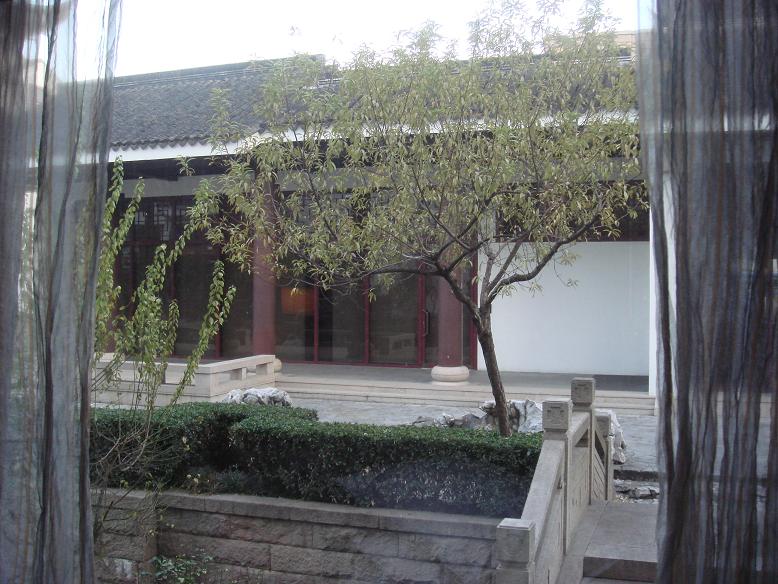
The hotel that we stayed in Suzhou was Pan Pacific which the tour guide claimed it's the best hotel among all the accommodations of our trip. I think the hotel is wonderful too since the guestrooms have a nice backyard view. Its architecture is like an ancient palace with a Chinese style garden in the centre.


Next morning, we visited Master of the Nets Garden 網師園, a UNESCO World Heritage Site. The two trees in front of Master of Nets Garden are Pagoda Trees 槐樹. The Chinese idiom 指桑罵槐 中的「桑」指桑樹,「槐」指槐樹,明明是罵槐樹,卻指著桑樹來罵. In ancient time, only rich family could grow 槐樹 (Pagoda Trees). But sometimes the wealthy ones treated the poors quite badly and it was illegal to point or scold at 槐樹. So people pointed to and scolded at 桑樹 (Mulberry Tree) to express their anger. Later it became a Chinese idiom - pointing to Mulberry but scolding at Pagoda tree.


Suzhou is considered one of the most beautiful cities in China because this place is famous for its classical gardens as we always hear "江南園林甲天下,蘇州園林甲江南" (Jiangnan gardens are the best in China, Suzhou gardens are the best in Jiangnan). Currently Suzhou has more than 200 gardens, some of the finest and representative ones are Great Wave Pavilion 滄浪亭, Humble Administrator's Garden 拙政園, Lingering Garden 留園, Lion Grove Garden 獅子林, Master of Nets Garden 網師園, Retreat & Reflection Garden 退思園. Now let’s go inside to Master of Nets Garden.


Wow, this gateway is very delicate with the exquisite carving! I really love the tiny carved figures.


Suzhou classical gardens were full of romantic ambience 詩情畫意 in ancient time. We can find it in Master of Nets Garden, for example the library (or the reading room) was very pleasant and romantic during the rainy days as the rain drops on the roofs created water curtains and the rain drops on musa basjoo (banana) leaves 芭蕉葉 by the window created nice sounds. In the meditation room, the combination of bamboos drawing and real bamboo trees outside the window creates harmonized scenery. The most popular spot of the garden is its pond with the pavilion where we saw many students drawing or sketching different views of the garden. Can you guess when the garden was first constructed? It was in 1140 during Song Dynasty, more than 800 years already!


Silk was originated in China more than 3000 years ago and it became very popular in the world. I’m sure everyone has heard of the Silk Road which was begun sometime in Han Dynasty (206 BCE – 220 CE) with the export of silk from China to Central Asia (today’s Shinjang 新疆), India, Persia (today’s Iran) and Arabia (today’s Middle East). The route was then expanded to North West Africa and Europe. Within China, Suzhou is the most famous in silk production. We visited a silk factory there to watch the expansion of cocoons. There were many products made from silk including luxurious quilts, beautiful scarves, face and hand creams, silk embroideries. One interesting fact according to our local guide: because the production of silk is very important in Suzhou, industrialization there is prohibited (I think is more likely minimized) since this will affect the quality of mulberry leaves which silkworms 桑蠶 are fed on as mulberry trees are very sensitive to the environment.

Wednesday, June 13, 2012

Trip to China (Part 2) – Wuzhen Water Village


In the afternoon of our second day tour, we travelled to one of the water villages in Jiangnan – Wuzhen 烏鎮. There are six well-preserved ancient water towns in Jiangnan including Luzhi 甪直, Nanxun 南潯, Tongli 同里, Wuzhen 烏鎮, Xitang 西塘 and Zhouzhuang 周庄. Since Jiangnan is located south of the Yangtze River, many streams flow through this region and that is how the water towns were developed. Most of them have long history of over a thousand years. Within the water villages, buildings are situated alongside waterways and stone-paved roads are connected across watercourses with stone arch bridges, which create charming and tranquil scenery. No wonder the ancient water villages in Jiangnan are often called “Venice in the East”.


Above is the tourist map of Wuzhen Xizha (West) Scenic Zone 烏鎮西栅風景區. Wuzhen water village is located in the North Zhejiang Province, just 45 minute bus ride away from Hangzhou. According to its webpage, the town is divided into four zones by a cross-shaped river, with the Beijing-Hangzhou Grand Canal running across the town, making it the only ancient water town adjacent to the canal.


Our tour was focused on Wuzhen Dongzha (East) Scenic Zone 烏鎮東栅風景區 where I saw High Pole Boat, walked through Fengyuan Twin Bridges 逢源雙橋, visited Xiangshantang Medicine Store 香山堂藥店, Ancient Bed Museum 江南百床館, Folk Custom Museum 江南民俗館 and Hongyuantai Dyehouse 宏源泰染坊.


The first thing that attracted my attention in Xiangshantang Medicine Store was the sign posted on the pole in the centre  "貨真價實 誠信無欺" (real products with fair price, honesty with no deceiving). I believe that was the basic concept of Chinese merchants in the past, but the Cultural Revolution has changed all the good concepts.


One of the classical, luxurious beds in Ancient Bed Museum is Babu Qiangong bed 清• 拔步千工床, made in Qing Dynasty with finest materials and complicated techniques. It was finished after 3 years (more than 1000 workdays). The size of the bed is 217cm long, 366cm deep and 292 cm high. Although it is a very elegant, high-quality wooden bed, I don’t think I would feel comfortable sleeping on it as I am used to soft bed.


Visiting Folk Custom Museum reminded me of中國二十四節氣 (Chinese 24 solar terms). The solar terms were invented by ancient Chinese based on knowledge in astronomy, climatology and agricultural meteorology. This system reflected the seasonal changes and was closely related to agricultural activities in ancient China. To make it simple, it has 12 major solar terms and 12 minor solar terms in the lunar calendar:

Start of Spring (立春), Rain Water (雨水) – February
Awakening of Insects (驚蟄),Vernal Equinox (春分) – March
Clear and Bright (清明), Grain Rain (穀雨) – April
Start of Summer (立夏), Grain Full (小滿) – May
Grain in Ear (芒種), Summer Solstice (夏至) – June
Minor Heat (小暑), Major Heat (大暑) – July
Start of Autumn (立秋), Limit of Heat (處暑) – August
White Dew (白露), Autumnal Equinox (秋分) – September
Cold Dew (寒露), Frost Descent (霜降) – October
Start of Winter (立冬), Minor Snow (小雪) – November
Major Snow (大雪), Winter Solstice (冬至) – December
Minor Cold (小寒), Major Cold (大寒) – January

This system and the lunar calendar only applies to China (or maybe East Asia), but sometimes I find it works in Vancouver too! We normally don’t put away our winter clothes until after Dragon Boat Festival (May 5 in lunar calendar) 未食五月粽,寒衣勿入櫳since we believe summer does not actually come before the festival. Now it’s already June but still sometimes cold in Vancouver, let’s see if it will be hot after Dragon Boat Festival (June 23 in western calendar)!


I was told that all the roofs of Zhejiang ancient architectures were built like this. Since the province rains a lot, the rain drops on the roof would create a water curtain!


Hongyuantai Dyehouse was founded between Song and Yuan Dynasty. Wuzhen is famous for its blue calico cloth 藍印花布. In the dyehouse, people use the same traditional methods to hand make the blue calico cloth. The dyeing process is environmental friendly since they use blue grass as dyeing material to make the blue calico. They also use natural grass, tealeaves, bark from mulberry tree and leaves of Chinese tallow tree for the unique process of colour printing.


According to its website, Wuzhen enjoys a history of over 1,000 years since its establishment in 872 A.D. The traditional buildings are still well preserved after crossing so many rough years. Within the town, with a dense network of rivers and wharves, people build their houses along the river and establish markets close to bridges. Stone railings and arch bridges, arched gates across the street, imposing dwellings and spacious courtyards, river banks and verandas are all well preserved.